
How Your Lawn Helps the Environment (Backed by Science)
Reviewed for accuracy and environmental research alignment.
Do lawns help the environment?
Short answer: Yes. Healthy lawns can improve air quality, reduce erosion, and absorb stormwater.
A healthy lawn does more than improve curb appeal—it plays a small but meaningful role in supporting the environment around your home.
Research from university extension programs and environmental agencies shows that well-maintained grass can:
- Capture carbon dioxide and release oxygen through photosynthesis
- Trap dust, pollen, and airborne pollutants
- Reduce stormwater runoff and filter contaminants
- Stabilize soil and prevent erosion
In regions like Pennsylvania, New Jersey, and Delaware—where heavy rain and dense suburban development are common—these benefits can have a real local impact.
Below, we break down exactly how your lawn contributes to a healthier environment—and what it takes to maximize those benefits.
5 Ways Your Lawn Helps the Environment
1. Natural Cooling: Your Lawn as a Built-In Air Conditioner
Grass cools your yard through evapotranspiration, a process where water evaporates from soil and transpires through plant leaves, lowering surrounding air temperatures.
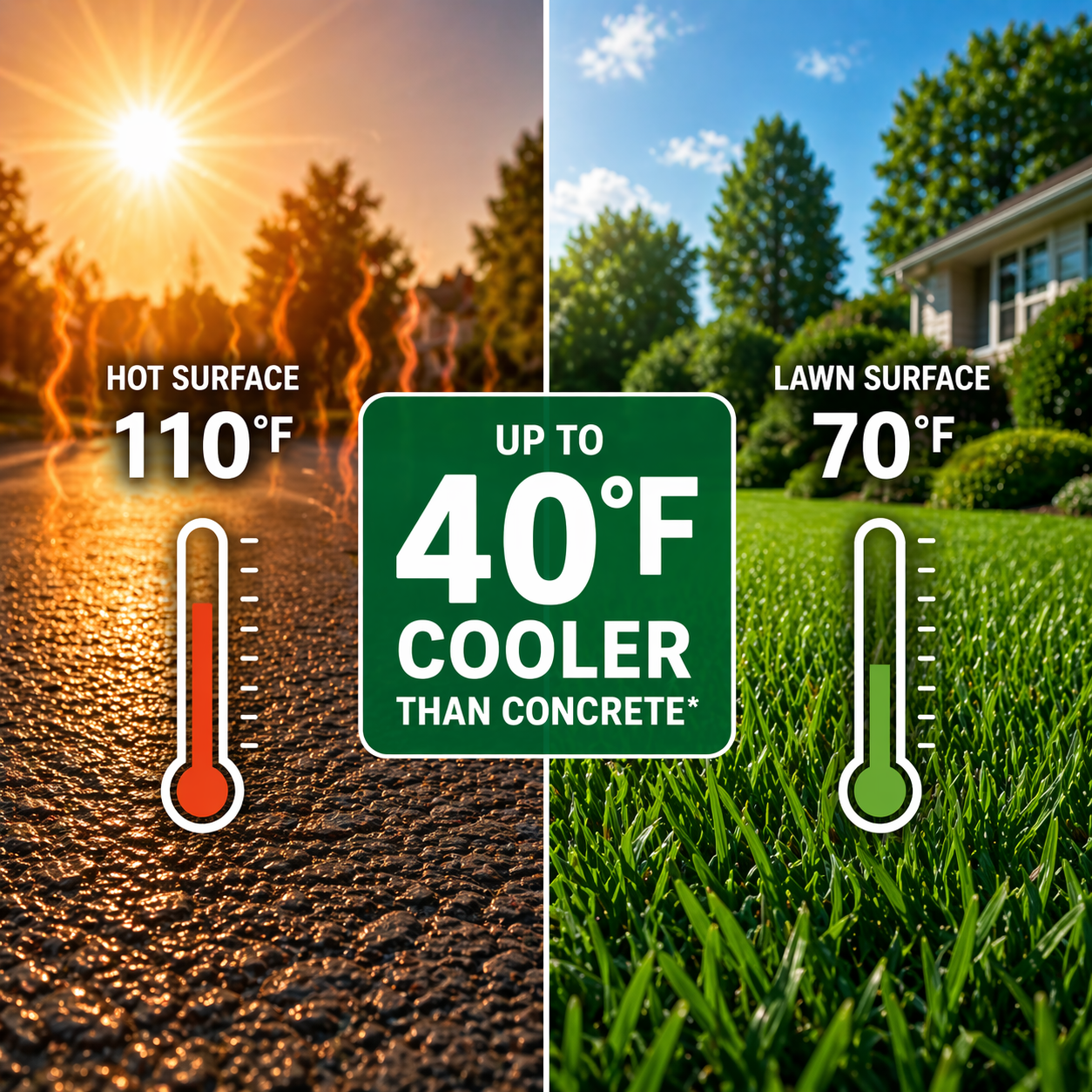
- Vegetated surfaces can be 20–45°F cooler than asphalt or concrete¹
- Turf reduces heat buildup around homes and structures
- Cooling effects can contribute to reduced energy demand for air conditioning
Source:
¹ U.S. Environmental Protection Agency, Heat Island Effect
https://www.epa.gov/heatislands
VIDEO: How Lawn Care Helps The Environment
2. Cleaner Air & Oxygen Production
Through photosynthesis, turfgrass absorbs carbon dioxide (CO₂) and releases oxygen (O₂), contributing to localized air quality improvement.
- Grass captures airborne dust and particulate matter
- Leaf surfaces help remove pollutants from the air
Research estimates:
- A 2,500 sq ft lawn can generate enough oxygen for a family of four²
- A 5,000 sq ft lawn may support 14–34 people daily, depending on conditions²
Source:
² Beard, J.B. & Green, R.L. (1994). The Role of Turfgrasses in Environmental Protection and Their Benefits to Humans. Texas A&M University
https://aggie-horticulture.tamu.edu
Carbon Sequestration in Turfgrass Systems
Turfgrass ecosystems store carbon in root biomass and soil organic matter, a process known as carbon sequestration.
- Long-term turf systems can act as net carbon sinks
- Soil carbon storage improves with proper management practices
Source:
³ Qian, Y. & Follett, R.F. (2002). Assessing Soil Carbon Sequestration in Turfgrass Systems. Agronomy Journal
https://doi.org/10.2134/agronj2002.0930
3. Soil Protection & Water Quality
Dense turfgrass provides measurable benefits for soil stabilization and water management.
- Reduces erosion by anchoring soil with root systems
- Improves water infiltration compared to bare soil
- Filters pollutants before reaching groundwater systems
University research confirms:
- Turf significantly reduces runoff and sediment loss compared to exposed soil⁴
- Root zones increase infiltration rates and water retention⁵
Sources:
⁴ Penn State Extension – Turfgrass and Water Quality
https://extension.psu.edu/turfgrass-and-water-quality
⁵ University of California Agriculture & Natural Resources
https://ucanr.edu
4. Supporting Local Ecosystems
While lawns alone are not full ecosystems, they contribute to broader environmental health when integrated into diverse landscapes.
- Provide habitat for soil microorganisms and insects
- Support bird activity when combined with trees and shrubs
- Serve as a foundational layer in suburban ecosystems
5. Eco-Friendly Lawn Care Practices That Matter
Environmental benefits depend heavily on maintenance practices.
Evidence-Based Lawn Care Guidelines
- Select regionally appropriate turf species
- Maintain proper mowing height (remove no more than 1/3 of blade)
- Apply ~1 inch of water per week (rainfall + irrigation)
- Use integrated pest management (IPM) strategies
Sources:
⁶ USDA Natural Resources Conservation Service
https://www.usda.gov
⁷ University Extension Turfgrass Programs (multi-state guidance)

Practical Steps to Improve Lawn Sustainability
- Core aeration to reduce soil compaction
- Overseeding to improve turf density
- Grasscycling (returning clippings to soil)
- Monitoring irrigation with rain gauges
- Incorporating native plant beds for biodiversity
Source:
⁸ EPA WaterSense Program
https://www.epa.gov/watersense
Professional Lawn Care & Environmental Efficiency
Professional lawn care programs can improve environmental outcomes when properly managed.

- Precision application reduces excess nutrient runoff
- Proper timing improves nutrient uptake efficiency
- Soil health issues can be diagnosed and corrected systematically
How to Make Your Lawn More Environmentally Friendly
If you want your lawn to actually deliver these environmental benefits, proper care matters.
That includes:
-
Applying the right nutrients at the right time
-
Improving soil health
-
Avoiding over-application of fertilizers
A professionally maintained lawn is not just greener—it’s more efficient, more resilient, and better for the environment.
Our expert lawn care programs are designed specifically for PA, NJ, and DE conditions, helping your yard stay thick, green, and environmentally responsible all season long.

This article is based on peer-reviewed research, university extension data, and federal environmental resources to ensure accuracy and reliability.